New Horizons in Immunotherapy: Lung Cancer Highlights from the 2025 SITC Meeting

The Society for Immunotherapy of Cancer (SITC) celebrated their 40th anniversary at their annual meeting in National Harbor, Maryland from November 5-9, 2025. The meeting focused on multidisciplinary research aiming to leverage the immune system to improve outcomes for cancer patients, including several exciting areas of growth in lung cancer-directed immunotherapy. Tumor Imaging is Growing More Powerful Advanced imaging techniques are poised to change how we understand and treat lung cancer without the need for invasive procedures. Researchers are working to use QVT radiomic scores (measuring

The Future of Lung Cancer Starts Here

For more than two decades, LUNGevity Foundation has been a leader in advancing lung cancer research. Since 2002, we have invested $55+ million in more than 200 research projects, helping to build a robust pipeline of discoveries in early detection, treatment innovation, and health equity. Once again, LUNGevity is ready to open our annual grant cycle in 2026 with five research programs designed to address the most pressing challenges in lung cancer care. In addition, these grants ensure the next generation of researchers is poised to continue making progress for everyone affected by this

Biggest News from Berlin: Research Highlights from ESMO

Lung cancer research was in the spotlight at the European Society for Medical Oncology (ESMO) meeting held October 17-21, 2025, in Berlin, Germany. With approximately 30,000 attendees from over 100 countries, this meeting gathered an international audience of clinicians, researchers, patient advocates, and representatives from the healthcare industry to discuss cutting-edge cancer research and share practice-changing clinical trial data. We saw data from studies that aim to build upon existing treatments, to optimize combination approaches, and to address some of the unmet needs of people

Small Cell SMASHERS Fireside Chat with Dr. Misty Shields

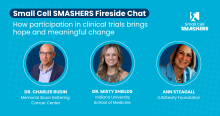
This special edition of the Small Cell SMASHERS features Misty Shields, MD, PhD, as a guest instead of her usual role as host. Dr. Shields is a thoracic medical oncologist, assistant professor of clinical medicine, adjunct assistant professor of medical and molecular genetics, and associate member of experimental and developmental therapeutics at Indiana University School of Medicine and Indiana University Health Physicians. Dr. Shields discusses her American Society of Clinical Oncology (ASCO) Career Development Award study for lurbinectedin and the role of predictive biomarkers. Moderated by

Small Cell SMASHERS Fireside Chat with Dr. Trudy Oliver

In November, Trudy Oliver, PhD, professor of pharmacology and cancer biology at Duke University School of Medicine and Duke Cancer Institute, discussed the origins of small cell lung cancer (SCLC) and its impact on plasticity. Moderated by Dr. Misty Shields, Indiana University School of Medicine, and LUNGevity’s Ann Fish-Steagall, SVP of Patient Services and Health Care Delivery, this monthly virtual series highlights the latest discoveries and breakthroughs for SCLC.
LUNGevity Foundation Invests $1.2 Million to Fuel Next Generation of Lung Cancer Research

LUNGevity Foundation announced $1.2 million in research awards that are designed to strengthen the lung cancer workforce and accelerate progress across the lung cancer continuum—from early detection to treating advanced disease. “Today’s research is tomorrow’s cure. If we want to see continued breakthroughs and advancements in lung cancer, we must secure a strong pipeline of researchers dedicated to improving outcomes for people with lung cancer,” said Upal Basu Roy, PhD, MPH, Executive Director of Research at LUNGevity Foundation. “To continue the momentum in lung cancer progress, we must

Celebrating Progress in Lung Cancer: From Detection to Survivorship

Over the past twenty years, lung cancer research and care have entered a new era. One filled with hope, innovation, and progress that is transforming what it means to face a lung cancer diagnosis. From groundbreaking early detection efforts to life-extending treatments, each step forward represents years of collaboration between researchers, patients, and others in the lung cancer community. Today, LUNGevity celebrates five exciting areas of progress that highlight the incredible strides made through sustained lung cancer research. 1. The Precancer Genome Atlas: Stopping Lung Cancer Before It

Small Cell SMASHERS Fireside Chat: Dr. Toby Campbell

In this Facebook Live on Tuesday, October 14, Toby Campbell, MD, MS, thoracic medical oncologist and chief of palliative care at the University of Wisconsin Health, discussed palliative care in small cell lung cancer. Moderated by Misty Shields, MD, PhD, IU Health, and LUNGevity’s Ann Fish-Steagall, RN, BSN, SVP of Patient Services and Health Care Delivery, the monthly Small Cell SMASHERS series highlights the latest discoveries and breakthroughs for SCLC.

Small Cell SMASHERS Fireside Chat: Dr. Sonam Puri

In this Facebook Live from September 30, Sonam Puri, MD, Department of Thoracic Oncology at H. Lee Moffitt Cancer Center, discusses the importance of real-world data for treating small cell lung cancer. Moderated by Misty Shields, MD, PhD, IU Health, and LUNGevity’s Ann Fish-Steagall, RN, BSN, SVP of Patient Services and Health Care Delivery, the monthly Small Cell SMASHERS series highlights the latest discoveries and breakthroughs for SCLC.

Why Do Some People Who Have Never Smoked Get Lung Cancer?

As tobacco use has declined in recent years, we have seen a new demographic of lung cancer patients emerge. Lung cancer in individuals who have never smoked (LCINS) is becoming more common. These people are often younger women with no history of tobacco exposure. Researchers are working to understand the needs of this growing population by identifying other risk factors for lung cancer, such as family history and environmental exposures. They are also studying the molecular underpinnings of this disease to develop targeted approaches for early detection and treatment. As part of LUNGevity’s